Advocate · Researcher · LL.M. Candidate

Sashwat
Gupta

"I am drawn to the intersection of law & power,
where real change happens (or should)"
Sashwat Gupta
10+ Internships
15+ Publications
3 Court Levels
5 Years of Study

Supreme Court · High Court · District Court

scroll ↓

Who I Am

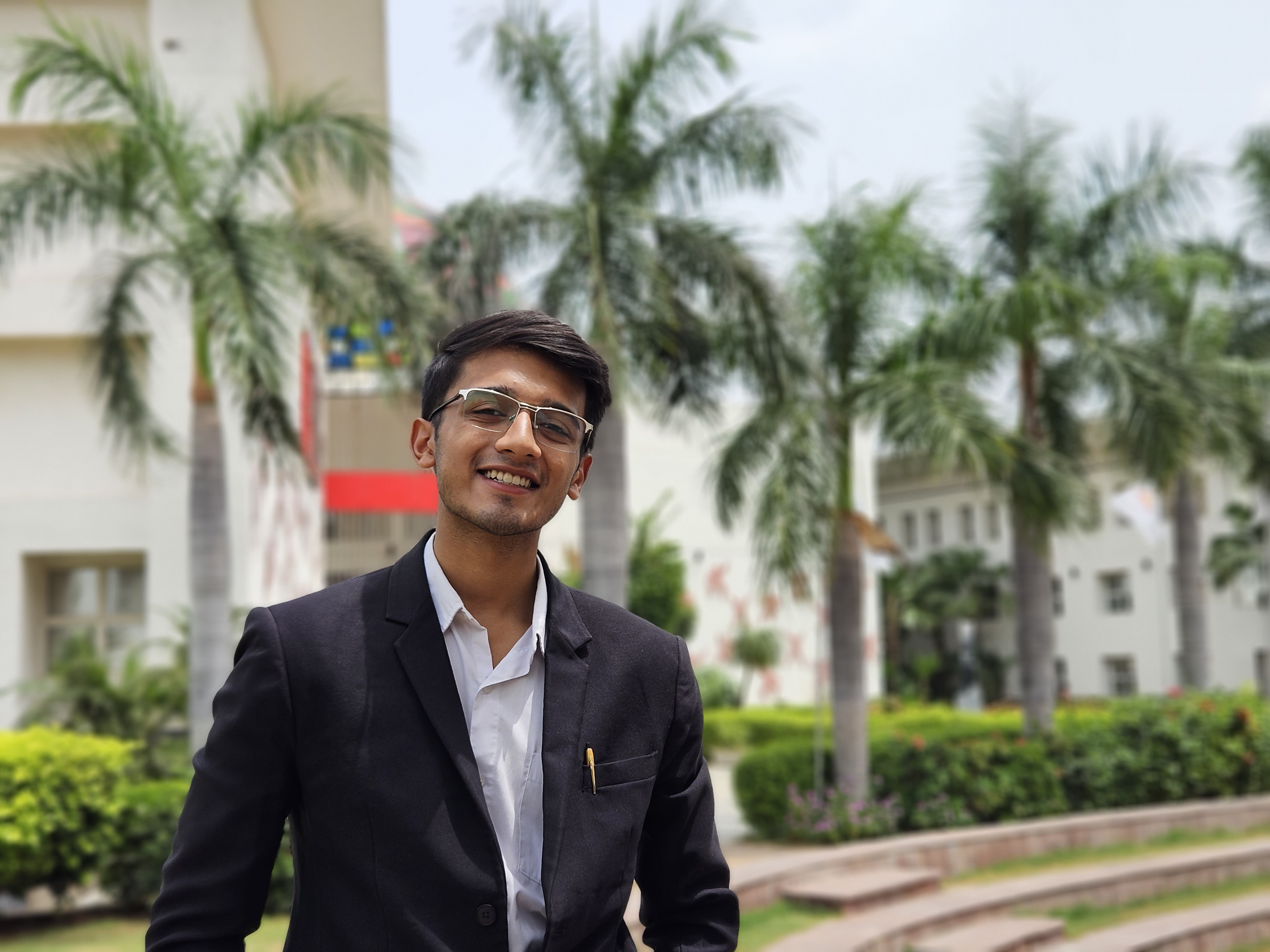
I am a legal researcher and advocate currently pursuing an LL.M. in Cyber Law & Cyber Crime Investigation at the National Forensic Sciences University, Bhubaneswar. My academic journey began with a B.B.A. LL.B. (Hons.) from Karnavati University, where I developed a deep interest in constitutional law, criminal justice, and the intersection of technology with legal frameworks.

My practice spans litigation exposure at the Supreme Court, High Courts, and District Courts — giving me a rare multi-tier perspective on how law operates in practice versus theory. I combine qualitative fieldwork with quantitative analysis, and I am particularly drawn to minority politics, media influence on vulnerable populations, juvenile justice, and law as a social instrument rather than mere doctrine.

I believe the most important legal questions are always also political ones — and that good lawyering requires knowing the difference.

Cyber Law Constitutional Law Criminal Justice Human Rights Forensic Law Legal Research Media & Society Juvenile Justice IPR Competition Law
Work Experience

Jan 2026 – Feb 2026Virtual

Intern

Scriboard Advocates & Legal Consultants

Jan 2026 – Feb 2026Supreme Court

Intern

Office of AOR Sindoora VNL, Supreme Court of India

Jan 2025 – Feb 2025Supreme Court

Judicial Intern

Office of Hon'ble Mr. Justice Sudhanshu Dhulia, Supreme Court of India

Dec 2024 – Jan 2025Supreme Court

Intern

Office of Additional Solicitor General of India, Aishwarya Bhati

Jun 2024 – Jul 2024District Court

Senior Intern

Adv. Anand Kashyap, Meerut District Court, U.P.

Dec 2023 – Jan 2024High Court

Judicial Intern

Office of Hon'ble Mr. Justice Saurabh Banerjee, High Court of Delhi

May 2023 – Jun 2023NGO

Intern

Prayas Juvenile Aid Centre, Delhi

Dec 2022 – Jan 2023Supreme Court

Intern

Adv. Surya Prakash Nigam, Supreme Court, Delhi

Jun 2022 – Jul 2022Heritage

Intern

Indian National Trust for Art and Cultural Heritage (INTACH)

Jan 2022 – Feb 2022District Court

Intern

Adv. Anand Kashyap, Meerut District Court, U.P.

Academic Background

2025 – 2026

LL.M. in Cyber Law & Cyber Crime Investigation

National Forensic Sciences University, Bhubaneswar, Odisha

Supervised by Dr. Bishwa Kallyan Dash

2020 – 2025

B.B.A. LL.B. (Hons.)

Unitedworld School of Law (UWSL), Karnavati University, Gandhinagar, Gujarat

2020

10+2 — Commerce & Informatics Practices (CBSE)

Rosary Senior Secondary School, Delhi

Positions of Responsibility

Sept 2025 – Present

Member — Legal Aid Committee

NFSU, Bhubaneswar

Aug 2024 – May 2025

Co-Convenor — Centre of Research for Human Rights

UWSL, Karnavati University

Oct 2024 – Jul 2025

Editor-in-Chief — Vyno Legal International Journal

Editorial Leadership

Jan 2024 – Jul 2024

Student Representative — Centre of Research for Human Rights

UWSL, Karnavati University

Sep 2022 – Aug 2023

Advisor — Legal Aid Clinic

UWSL, Karnavati University

Jul 2021 – Aug 2022

Creative Head — Legal Aid Clinic

UWSL, Karnavati University

Research & Writing

Research Papers

  • Juvenile Recidivism in India: A Socio-Legal Analysis of Contributing Factors and Rehabilitation StrategiesVyno Legal International Journal · Apr 2025
  • Media Coverage of Vulnerable Groups: Legal Protections and Ethical ConsiderationsLex Lumen Research Journal (ISSN: 3048-8702) · Nov 2024
  • Electronic Evidence Admissibility in Indian Courts: Challenges and SolutionsVyno Legal International Journal · Nov 2024
  • Child Protection Schemes as part of Policymaking in IndiaVyno Legal International Journal · Nov 2024
  • Competition Law & IPR Issues in Technology Transfer Agreements and LicensingCSRIPR, NUSRL · Jun 2024
  • Victim Impact Statement: Relevance in the Indian Criminal Justice SystemInternational Journal of Legal Affairs & Exploration · Jul 2024 · Also in Legally Bound: Criminal Justice, Vol. 2
  • Pendency of Cases: A Glitch in Indian Judiciary Being a Hindrance for SDG-16Indian Journal of Law and Legal Research (ISSN: 2582-8878) · Apr 2024
  • Role of Courts in Correctional Institutions in India, US, and BangladeshIndian Journal of Law and Legal Research (ISSN: 2582-8878) · Apr 2024
  • Meaning of the term "Service" under Goods and Services Tax ActAcademike by Lawoctopus · Sep 2024

Articles & Case Analyses

  • D. Saibaba v Bar Council of India — Case AnalysisLegal Service India · May 2023
  • The Doctrine of Caveat EmptorThe Legal State · Jan 2022
  • Section 121 of the Indian Penal CodeLegal Service India · Dec 2021
  • Artificial Intelligence and LawLawyers Club India · Feb 2021
  • The POCSO Act — A Fallacious Solace?The Legal State · Feb 2021
  • Ayaaubkhan Noorkhan Pathan v State of Maharashtra & Ors — Case AnalysisThe Legal State · Mar 2021
  • Victim Impact Statement: Relevance in the Indian Criminal Justice SystemSSRN · May 2024

Certifications

  • Intellectual Property RightsKarnavati University & DPIIT
  • International Maritime LawGujarat Maritime University
  • Schools of JurisprudenceThe LAW Learners

Community & Outreach

Co-Convener

Centre of Research for Human Rights (CRHR), UWSL Aug 2024 – May 2025

Student Representative

Centre of Research for Human Rights (CRHR), UWSL Jan 2024 – Jul 2024
  • Community engagement campaigns in nearby villages
  • "हुनर को प्रणाम" (Hunar ko Pranam) — recognising students at SEDI Vocational Centre as part of the Right to Livelihood project
  • Celebrated Holi at Boys Welfare Home, Sector 19, Gandhinagar
  • Organising team for "Open Discussion on Women Empowerment through Arts Activism" (KCEIL & CRHR)

Advisor — Legal Aid Clinic

UWSL, Karnavati University Sep 2022 – Aug 2023
  • School visit at Shertha Village, Gandhinagar
  • Volunteering for National Lok Adalat at District Court, Gandhinagar
  • Environment Drive at Primary School No. 1, Gandhinagar
  • Legal Awareness at Special Children's Home, Gandhinagar
  • Blood Donation Drive with Red Cross at Karnavati University
  • Environment Drive at Uvarsad Kumarshala with awareness on Legal Aid & Tele-Law

Creative Head — Legal Aid Clinic

UWSL, Karnavati University Jul 2021 – Aug 2022
  • NGO Camps and Legal Aid Camps (2021)
  • Survey Program at Vavol Village, Gandhinagar
  • Director & Supporting Role — "The Making of the Constitution" (2021)
  • Hospital Outreach Program in Gandhinagar
  • Legal Awareness on POCSO Act at Uvarsad Kanyashala (2022)
  • Director & Supporting Role — "Awareness on LGBTQIA+ Rights" (2022)
  • Rural Survey & Awareness on Free Legal Aid (2022)

The Person Behind the Brief

When I'm not buried in case law or research papers, you'll find me with a book in one hand and a cat in the other — ideally both at the same time.

📚

Reading

From legal theory to fiction — I read widely and believe every good lawyer is first a good reader.

✈️

Travelling

New places, new perspectives. Travel has shaped how I understand people and the societies law is meant to serve.

🌱

Gardening

There's something grounding about growing things — a quiet counterweight to the intensity of legal work.

🎬

Cinema

Movies are how I decompress — and occasionally find better arguments than any case I've read.

🐱

Cats

Proudly a cat person. Independent, quietly judgemental, and entirely unbothered — qualities I deeply respect.

Writing Samples

Two selected works that represent my research voice — one on criminal justice, one on media and human rights.

Criminal Justice · SSRN · 2024

Victim Impact Statement: Relevance in the Indian Criminal Justice System

International Journal of Legal Affairs and Exploration · Jul 2024 · Also published in Legally Bound: Exploring the Tapestry of Criminal Justice, Vol. 2, Part 2

+

Abstract

This paper explores Victim Impact Statements (VIS) and their role in the criminal justice system. It examines the historical development of victim rights and the limitations faced by victims in traditional legal systems. VIS are introduced as a tool for victim empowerment, allowing them to share the impact of crimes and participate in the sentencing process.

The paper analyzes the purposes served by VIS — including informing sentencing decisions, promoting victim participation, and countering secondary victimization — and explores the mechanics of VIS delivery, including formats, timing, and limitations. Legal perspectives are explored, comparing common law and civil law traditions regarding VIS presentation during guilt and sentencing phases.

The paper critically examines arguments against VIS, including potential for bias, emotional manipulation, and disruption of sentencing procedures. It highlights Payne v. Tennessee (1991) as a landmark decision in the US regarding VIS admissibility. Focusing on India, the paper discusses the limited role of victims in the current criminal justice system, critiques the lack of established sentencing guidelines, and raises concerns about potential delays in case processing due to VIS considerations.

Despite these shortcomings, the paper emphasises the importance of victim rights and advocates for VIS as a tool for victim empowerment — particularly for those facing violence within social taboos — and calls for further exploration of VIS implementation across cases within India's legal system.

Research Focus

Victim Rights Sentencing Reform Indian Criminal Justice Comparative Law Secondary Victimization

Publication Note

This paper was originally published on SSRN (May 2024) and subsequently cleared peer review to be included in the edited volume Legally Bound: Exploring the Tapestry of Criminal Justice, Vol. 2, Part 2 — a distinction that reflects the paper's reception within the academic legal community.

Read on SSRN ↗
Media Law · Human Rights · 2024

Media Coverage of Vulnerable Groups: Legal Protections and Ethical Considerations

Lex Lumen Research Journal, Vol. 1, Issue 2, Pages 80–95 · ISSN: 3048-8702(O) · November 2024

+

Abstract

This research examines the intricate dynamics between media, vulnerable populations, and human rights in developing nations undergoing democratic transitions. It defines vulnerable groups as those at higher risk of needing humanitarian aid or exclusion from social services, and explores how media functions as both a potential catalyst for conflict and a champion of human rights.

The paper examines challenges faced by vulnerable populations in accessing digital media and the ethical dilemmas encountered by journalists when reporting on sensitive issues. It analyses India's Press Council of India alongside international organisations like UNESCO, highlighting the complex interplay between media regulation, press freedom, and human rights protection.

Key Arguments

  • Media in transitional democracies serves dual roles — it can entrench conflict through passive incitement or act as a watchdog against human rights violations.
  • India's media regulation framework, centred on the Press Council of India, lacks statutory enforcement capability — a critical gap when covering marginalised communities.
  • Case studies from Manipur, Ladakh, Canada (Idle No More), Australia, the US (Black Lives Matter), and Europe (Roma Communities) illustrate global patterns of inadequate representation.
  • Algorithmic bias on social media platforms creates echo chambers that exacerbate existing inequalities for vulnerable groups.
  • Responsible journalism with vulnerable sources requires transparency, collaboration with community experts, and prioritising source safety and consent above the story.

Research Methodology

Doctrinal research combined with descriptive analysis, examining statutory provisions, case law, and international regulatory frameworks. The research draws on 14 sources spanning academic journals, legal guides, and investigative journalism ethics literature.

Excerpt — Introduction

"Media plays a vital role in vulnerable societies, particularly those susceptible to civil conflicts and repressive rule... Being an immediate source of information, it can readily serve as a powerful tool in promoting enmity or nondemocratic rule, or deliberate manipulation of media outlets to promote conflict... However, it is crucial to acknowledge that media also serves as an immediate watchdog, raising awareness about the issues of Human Rights and any of its infringement, empowering citizens to take action."

Research Focus

Media Law Vulnerable Communities Journalist Ethics Press Freedom Digital Divide Human Rights
Read Full Paper ↗

Get in Touch

Whether you're a recruiter, researcher, or fellow legal mind — I'm always open to conversations that matter.

💬
SG

Sashwat's Assistant

Ask me anything about Sashwat

Hi there! 👋 I'm Sashwat's assistant. Ask me about his background, experience, research, or how to get in touch.